Who needs a VPN anyway?
How your data hops across untrusted middleman nodes to reach you, who gets to inspect it along the way, and why that quietly shapes your behaviour.
As previously discussed; the internet is a collection of interconnected computers, commonly referred as nodes. When your computer requests data the sender must dispatch it (over the wire) through many intermediate nodes until it reaches you. This strategy for dispatching data is commonly referred to as the store and forward model. But how do all these intermediate nodes know where to redirect the data so it gets to you? Well, there are a few rules to this game.
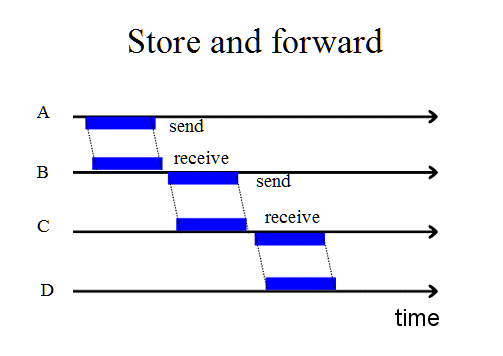
There is a limit to how big the sent data can be, this is because there's an actual physical limit which is why an optimal size has been established. To overcome this limitation, data is split into smaller packets. Each packet or IP Packet contains a source and a destination address. Sounds familiar? This is how a postal service may implement their dispatching model.

The relay between sender to receiver may involve several intermediate nodes, where each node will inspect the packet and forward it closer to its final destination. When the requested data finally arrives to you it has been inspected by many different nodes.
But why should we care about middlemen glancing over our data? As we mentioned in our previous article; The internet isn't trusted because of its architecture, but because of its users. Allowing third parties to inspect even just the route of your data can have several ripple effects:
- Gain commercial advantage. If a third party or ISP is affiliated to a certain vendor and you purchase from its competitor, said party may slow down ('throttle') or even block access to it. Since your overall experience with the vendor was poor, next time you purchase the same or similar item you will consider its competitor.
- Build a commercial profile. By analysing your data, a third party may build a profile of your preferences, correlate them with your local peers and sell the findings to a vendor. Ever wondered why everybody gets the same kind of adverts in the same area?
- Censoring Information. A third party could have an affinity for a certain topic and could therefore block access to the opposition.
Small misdirections such as throttling would ultimately change your behaviour.
I will leave you with this reflection: 20% of the causes are responsible for 80% of the effects. The law of the vital few or Pareto Principle can be traced down to human behaviour in the form of habits. Allowing others to determine how you interact with the world will ultimately change you, only you won't be able to notice.
There are other reasons to use a VPN, such as privacy (not secrecy) and net-neutrality. I will be writing about them as they all deserve attention, until then. 👋
Originally published on Medium.
Questions about the build, or building something similar? Say hello. I read every message.